
So we’ve all pretty much defaulted to PMAX as the default choice for our Google Ads campaigns. Google won in the end. I’ve got a question for you, though. When one channel is carrying the entire weight of your paid performance, handing budget control to an algorithm that spreads it everywhere else… is this a strategy or a subsidy?
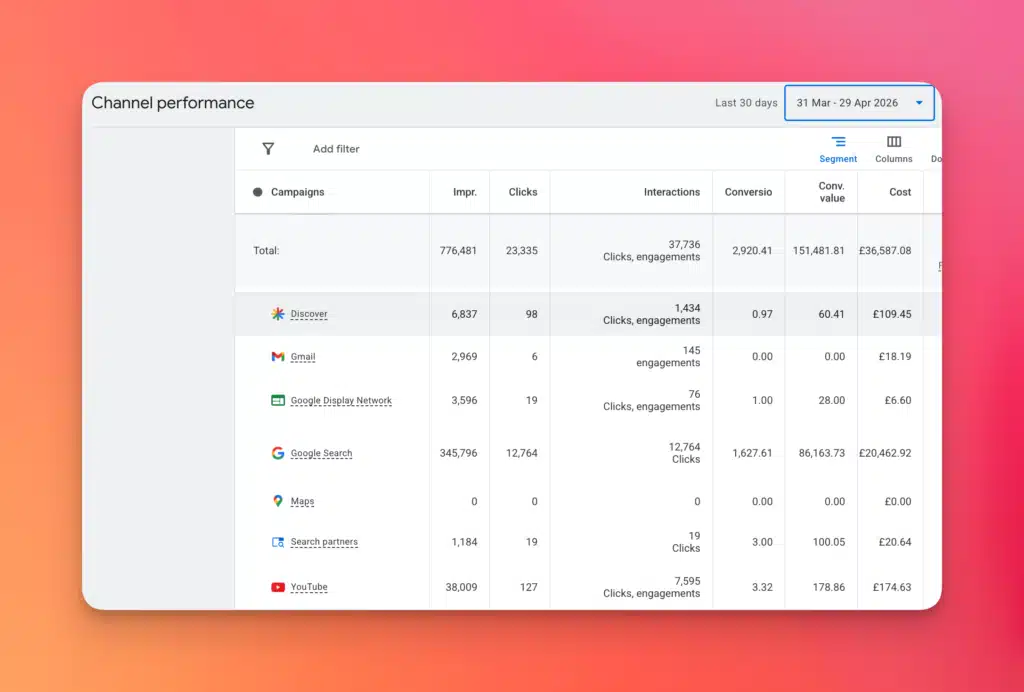
I want to show you a channel performance breakdown from a Google Ads account I recently audited as an Ecommerce Growth Unlock. It’s the kind of data that tells you everything you need to know about where your paid budget should (and shouldn’t) go.
Channel breakdown — Google Ads
| Channel | Impr. | Clicks | Conv. | Conv. value | Cost |
|---|---|---|---|---|---|
| Google Search + Shopping | 345,796 | 12,764 | 1,627.61 | £86,163 | £20,463 4.2x ROAS |
| YouTube | 38,009 | 127 | 3.32 | £178 | £174 |
| Discover | 6,837 | 98 | 0.97 | £60 | £109 |
| Google Display Network | 3,596 | 19 | 1.00 | £28 | £6.60 |
| Gmail | 2,969 | 6 | 0.00 | £0 | £18.19 |
| Search partners | 1,184 | 19 | 3.00 | £100 | £20.64 |
Look at that Search and Shopping row. £86,163 in conversion value from £20,463 in spend. A 4.2x ROAS. 1,627 conversions. Over 12,000 clicks from 345,796 impressions.
Now look at everything else. YouTube spent £174 to generate £178 in conversion value, and that’s being generous about how much credit those conversions actually deserve. Discover spent £109 for less than one conversion. Gmail: £18 and nothing. Display: one conversion for £6.60, which sounds cheap until you ask whether Google genuinely drove that sale or just claimed the assist.
This is what a Google Ads account looks like when Search and Shopping are doing the job properly, and everything else is along for the ride.
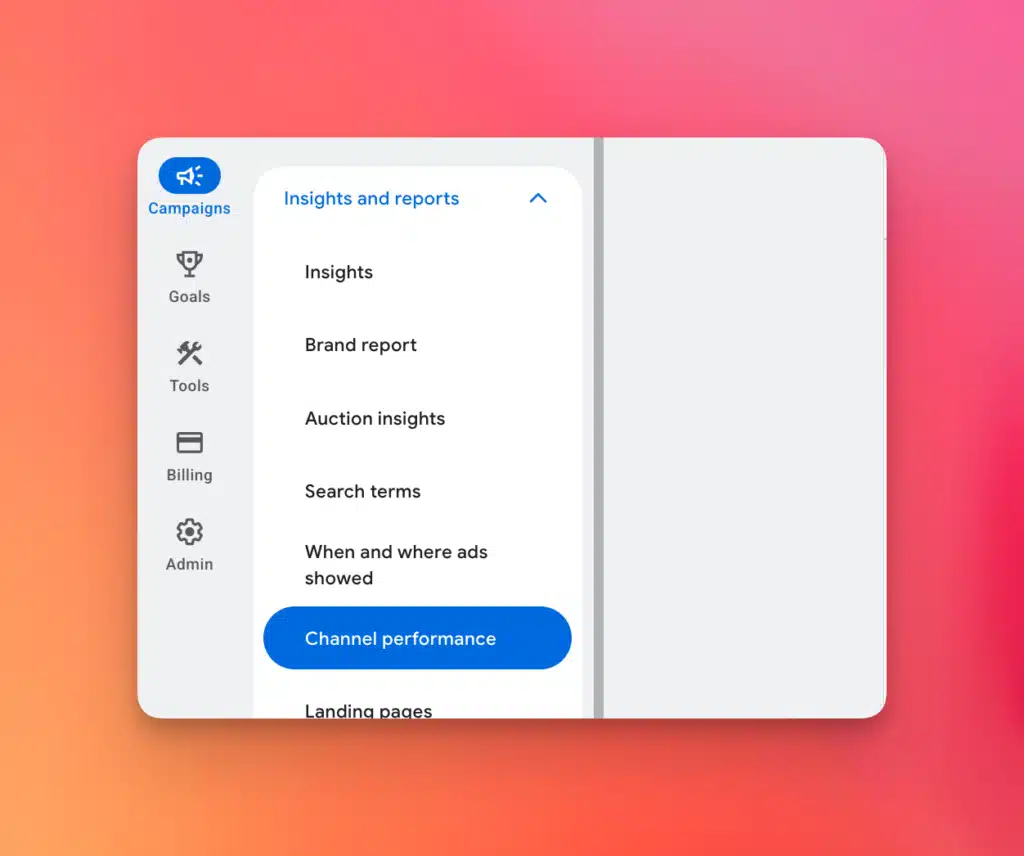
You need to look at your Google Ads Channel Performance report as a matter of urgency. Even if your agency runs your campaigns – make sure you’re aware of where your budget is being allocated….
How Performance Max (PMAX) Actually Allocates Your Google Ads Budget
Performance Max campaigns are Google’s packaging of all these channels into a single campaign type, where the algorithm decides how to allocate your budget across Search, Shopping, Display, YouTube, Discover, Gmail, and Maps. You hand over creative assets, set a target ROAS or conversion goal, and Google does the rest.
The pitch is compelling. One campaign, all channels, smart allocation. But the data above shows the problem clearly: Google’s idea of “smart allocation” includes spending real money on channels that probably don’t convert for your business. Is the algorithm making bad decisions through ignorance? The skeptic in me says that it’s optimised for Google’s revenue model, not yours.
When you run PMAX, you’re telling Google to distribute your budget across all these surfaces. The data is telling you that’s a bad idea.
What You Sacrifice With PMAX: Control, Visibility, and Bidding Precision
Control. That’s the plain answer. Specifically, you lose the ability to bid differently by intent level, to exclude placements that waste spend, to structure campaigns around your actual purchase funnel, and to see clearly where your conversions are coming from.
PMAX does provide a network breakdown, but it doesn’t give you the granular search term data that standalone Search campaigns do in plain sight. You can see which queries are driving your best customers, hidden away in the Search Term Report. You can’t separate branded from non-branded performance. You’re flying with less visibility over your most important channel.
For an ecommerce brand with strong Search and Shopping performance, this trade-off doesn’t make sense. You’re not struggling to find volume. You’re not short on converting intent. The demand is there. The job is to capture it efficiently and stop subsidising channels that aren’t pulling their weight.
When You Should Shift Budget From PMAX to Dedicated Search and Shopping Campaigns
With budget freed from underperforming channels, the focus shifts to maximising what’s already working. That means tighter campaign segmentation by product category, more disciplined match type management, aggressive negative keyword development, and sharper bidding strategies at the campaign level rather than letting a single algorithm smooth everything together.
It also means better Shopping campaign architecture. Product feed quality, bidding by margin or ROAS target per product group, and clear separation between brand and generic terms all compound over time. These aren’t glamorous optimisations, but they’re the kind that build lasting performance advantage rather than obscuring it inside an opaque algorithm.
My honest take: PMAX works well in specific circumstances. New brand launches with limited historical data. Businesses with genuinely strong creative assets for video and display. Accounts where Search volume alone can’t hit growth targets. If none of those apply to you, and your Search and Shopping data looks anything like the breakdown above, PMAX is serving Google’s interests more than yours. Take back the controls.
The Key Caveat: Measuring Display and YouTube’s Upper-Funnel Impact Before You Cut Them
Before you kill every non-Search campaign, it’s worth asking whether Display and YouTube are doing any unattributed work. Upper-funnel exposure that eventually converts through Search won’t show up in last-click attribution. A view-through window analysis or a geo-based holdout test can help you answer that question properly.
If that upper-funnel activity were genuinely moving the needle, you’d expect to see it in your branded Search volume, your direct traffic, your organic conversion rates. If none of those are growing while Display and YouTube spend real money month after month, the answer is probably what the data already suggests.
The numbers don’t lie. Your Search and Shopping campaigns are doing the job. Build on that and stop diluting it.

