
Google Analytics is an ecommerce marketing specialism in itself. That’s why I entrust my clients to Jason Riddle. He’s my go-to man on Analytics integration, support and logic. I’ve asked Jason to provide insight into the value Google Analytic’s Enhanced Ecommerce can provide your ecommerce business. Here’s his response…
Knowing how visitors are finding your website, what they do on it and where they leave it is essential information for any e-commerce business.
Customer journey insight that allows you to:
- improve the targeting of your marketing and AdWords campaigns
- identify problems with the checkout and any other features that customers use to find, select or compare products
- understand the paths visitors follow through the website and see what information is important to them and what offers interest them
- to know which products they are looking at and which of these they are buying.
You’re likely already using Google Analytics.
Most websites have Google Analytics installed, but often it is just in its basic form.
Standard Google Analytics integration will record which pages your visitors are looking at and will be able to capture how some of your visitors find your site, but that’s about it.
To record additional activity requires further configuration. Event tags can be added to your pages to record on-page activity such as e-mail sign-ups, on-line chats, video views or how far down the page the visitor has scrolled. Additional features such as site search tracking, to see what people are searching for on your site, and content grouping, to see how people are navigating your site can be set-up. AdWords and Google Search console accounts can be linked and their data incorporated for analysis alongside your other Google Analytics Data. But for a shop site some of the biggest gains can be achieved by implementing Google Analytics’ Enhanced Ecommerce.
Google Analytics E-commerce and Enhanced E-commerce
Google Analytics has two levels of e-commerce tracking, the standard e-commerce integrates transaction data into your site’s visitor data. It provides quick and easy access to online sales data and incorporates this with detailed information about visitor acquisition and visitor acquisition channels. Enabling sales to be attributed to marketing campaigns and the data to be segmented by customers, repeat customers and non-customers, as well as by product or product category or any other visitor characteristic recorded in Google Analytics.
Google Analytics Enhanced Ecommerce (GA EE) builds on top of this a product-centric view of visitors’ shopping behaviour on your site as well as detailed tracking of their activity through your checkout process. It provides 5 product categories plus brand and variant so analysis can be made from product group level down to the very granular: product size or colour.
GA EE facilitates in depth analysis and reporting that will help you understand how people are using your website and to improve conversions based on this by answering questions like these:
How well is your checkout working?
Google Analytics Enhanced Ecommerce can track visitors through each step of the checkout process and the selections they make such as delivery options and payment method at each stage. This data is presented in an easy to digest graphical format that can be segmented by user behaviour and characteristic.
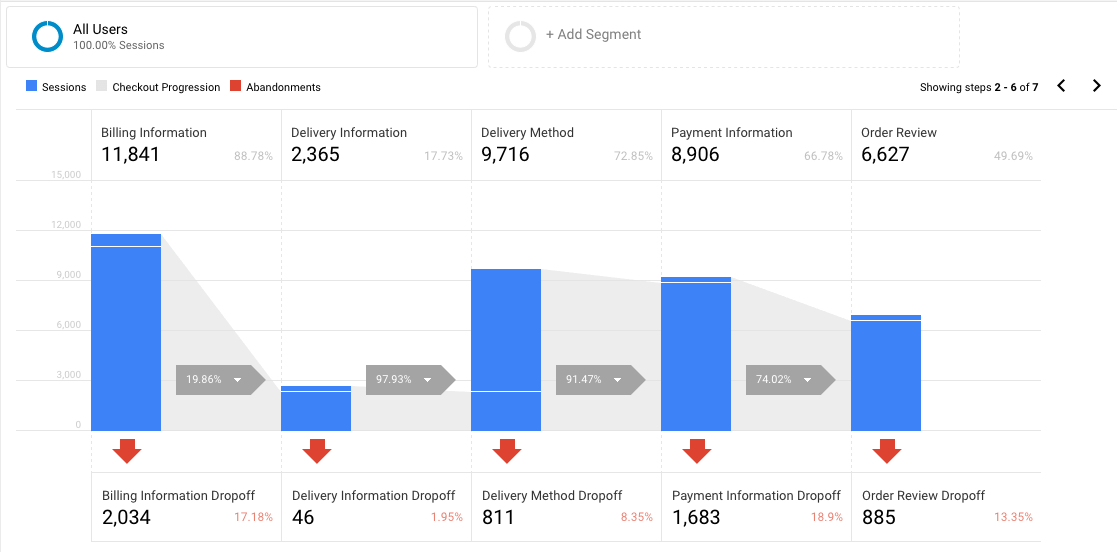
Nowadays, it is common for websites to offer visitors the option to checkout through PayPal rather than the site’s built-in checkout, and some even offer a separate credit-application checkout for high value purchases. Tracking how visitors use these options and how they perform on mobiles, tablets and desktops will help you structure and present the checkout process in the most effective and profitable way.
What products are being looked at and are they being bought?
Google Analytics Enhanced Ecommerce records which products are displayed to visitors on catalogue pages, in search results or other listing pages and in what position they appear. As well as the number of times visitors drill down to the product pages for each product from these listings, how many times the product is added to the basket, enters the checkout and is finally purchased.
This level of detail enables you to see product based conversion rates that highlight which products are underperforming that might benefit from a review of their product page. Identify if some products are being abandoned in the checkout more than others. And if a product isn’t selling you can work out if it is because it isn’t being seen, or if it is being seen but rejected.
Are my promotions working?
Google Analytics Enhanced Ecommerce can also keep track of the display of onsite promotions, recording the displays, clicks and any subsequent transactions as well as the use of coupon codes that you might publish offsite with affiliates or through email campaigns. And subsequently the cost of these promotions and assess their impact on sales.
Do your customers buy from multiple product categories?
For sites that sell a large range of products the product categories can be used to identify if customers tend to stick to buying one category or if there is any commonality between different categories, which can help with cross-selling either on the site or through promotional emails.
Why use Enhanced E-commerce?
There are many other questions that can be analysed and answered, ultimately Enhanced E-commerce is a tool that helps you understand what the consumers want. The challenge is to use this information to improve your websites performance in balance with what the business is trying to achieve.

