
All my consulting work circles around ‘next phase ecommerce growth’. It’s the challenge I’m set running this consulting business now for my 16th year.
Growth, for most, aligns to spend. You spend more on ads… you ‘grow’ more.
So, what you do when paid media starts to run its course as your primary growth driver? And there’s a question, on repeat, I hear from DTC founders on my weekly calls, usually framed as a cost challenge: “We’re tight on budget. Should we really be investing in owned media, DIY growth, and brand building right now, or should we just focus on what converts? What’s always worked? the ads that bring in the sales now?”
It’s a reasonable question on the surface. Is it the right one to be asking? I’m getting good at answering this question, so let’s dive in.
Okay, so what would be a more suitable question? “what happens to our business the moment we stop paying for traffic?” Ouch.
If the honest answer is “it stops,” you’re running a paid media operation wearing a brand’s clothing.
And I’ll caveat everything I’m about to share with you by saying owned-media is an absolute must for a premium brand looking to build a moat around their business.
The Surface Problem: Misdiagnosing DTC Growth as a Paid Media Issue
Most DTC brands hitting a growth ceiling look at their numbers and see a paid acquisition problem. CAC is rising. First-order ROAS is declining. They push harder on ads, test more creatives, hire a better media buyer. All the best practice tactics you’re taught.
The misdiagnosis here is almost universal. They’re treating a symptom as if it were the disease.
The disease is that nothing is pulling customers toward them. Every single order has to be bought. There’s no gravity in the growth system.
What’s Actually Happening: You’re Buying Every Order Instead of Building Brand Pull
When I look at a DTC brand that’s entirely dependent on paid to drive volume, here’s what I usually find hidden underneath:
Branded search is near zero. Nobody is typing their name into Google because they thought about them unprompted. Direct traffic is negligible. Email open rates are declining because the list is full of one-time buyers who didn’t really choose the brand, they just happened to be in the ad’s path at the right moment and fancied the idea of a 10% discount.
That’s not what I’d call a customer base. It’s more like a list of people who responded positively to an offer. Who doesn’t like an offer?
The growth machine framing I use with founders is simple: traffic quality, conversion system, offer strength, and retention. Owned media doesn’t live in just one of those buckets. It affects all four. A brand that people actively seek out brings higher-intent traffic, converts at a stronger rate, commands a better AOV, and retains customers because those customers made a real choice. Sounds good, right?
Strip out the brand equity and what you’re left with is a pure price-and-availability commodity. Good luck defending that margin long-term.
The Branded Search Signal: How Branded Queries Reveal Real Brand Growth and Retention
There’s a document I’ve been reviewing in my weekly calls with Google that makes a solid point: branded search is a direct proxy for whether your brand-building is working.
When someone searches your brand name, they have already decided they want you. The conversion rate on branded search is almost always the highest in your entire acquisition mix. The CPC is lower because you have the highest quality score for your own name. Competitors cannot economically outbid you for your own brand terms.
If branded search volume is flat or declining, your brand is not growing, right? New customers are finding you, buying once, and then failing to encode your name as the answer to their problem.
That’s a retention and LTV problem. It’s also a CAC problem, because you’re permanently dependent on cold acquisition for every single order.
The Unlock: Using Owned Media to Shift from Bought Demand to Earned Demand
The fundamental constraint for a DTC brand that won’t invest in owned media is this: you are only ever buying demand that already exists elsewhere. You’re renting attention from platforms that will raise the price the moment your competitors do the same.
Owned media, whether that’s your YouTube channel, email as a genuine communication channel rather than a promotional firehose, content-first SEO, your community, or whatever is right for your category, builds earned demand. People come looking for you. They recall you when the need arises. They tell someone else.
The payback on that is slow and hard to attribute. That’s exactly why most brands don’t do it. And it’s exactly why the ones that do have a structural cost advantage in acquisition within 9 to 12 months.
A tool like SEOTesting is worth using here because it makes the compound effect of organic investment visible over time. You can see whether your non-branded content is generating the kind of search visibility that eventually feeds branded recall. Without measuring it, you’re flying blind and making decisions purely on last-click.
What This Unlock Enables: More Stable CAC and Stronger LTV from Earned Demand
When earned demand starts to build alongside paid, a few things happen that change the unit economics of the whole business.
CAC stabilises. You’re no longer entirely at the mercy of auction dynamics. The customers arriving through organic or direct channels have higher LTV because they chose you, not just your ad. Payback periods compress. And when you do spend on paid, you’re amplifying genuine demand rather than manufacturing it from scratch every single day.
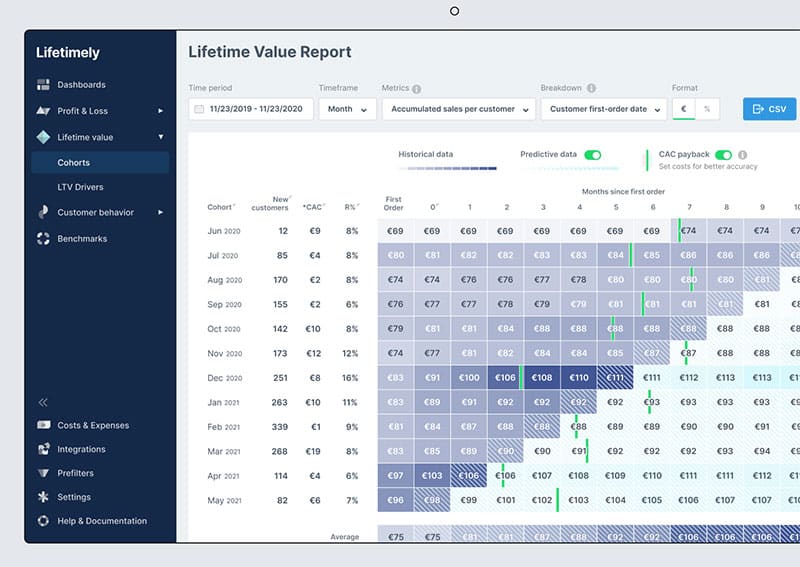
Lifetimely is the right place to pull this analysis. Look at cohort LTV by acquisition source. In almost every brand I’ve looked at, customers acquired through branded search or organic have materially better 12-month LTV than those acquired through cold paid social. The difference is usually large enough that it changes the conversation about where to invest entirely.
Why my clients use Lifetimely;
True profit visibility (not vanity metrics)
Consistently praised for showing real profitability, not just top-line revenue.
Deep LTV and cohort insights
Helps brands understand customer value over time
Removes guesswork from CAC decisions
Automatically calculates CAC and ties it to LTV, so you know what you can afford to spend.
Simple dashboards that drive action
Clients love how easy it is to interpret data and actually use it to make decisions.
Daily decision-making tool (not just reporting)
Many clients describe it as something they rely on every day, not just a monthly report.
All your key metrics in one place
Unifies profit, marketing, customer and product data into a single view of the business.
The Challenge: Short-Term Cash Decisions That Starve Brand and Owned Media
Most founders who deprioritise brand building are not making a strategic decision. They’re making a short-term cash management decision and calling it strategy.
That’s understandable. Brand investment is uncomfortable because the feedback loop is long and the attribution is fuzzy.
But ask yourself this: if you turned off paid tomorrow, what would be left? If the answer is very little, you’ve been building your media platform’s business, not yours. Google thanks you. Meta thanks you. They’d be grateful for even further investment.
Over a five-year horizon, those who decided early that owned media was infrastructure, not a nice-to-have are in a good place. Start building it now, before the paid economics force you to.

